
The problem with a confident answer
Ask most AI tools a theology question and you get a fluent answer with no way to check where it came from. For a subject where the tradition and the sources matter, that is not good enough. ExplainBible was built to answer anything a person asks in their own words, and to make every answer traceable to the text and the sources behind it.
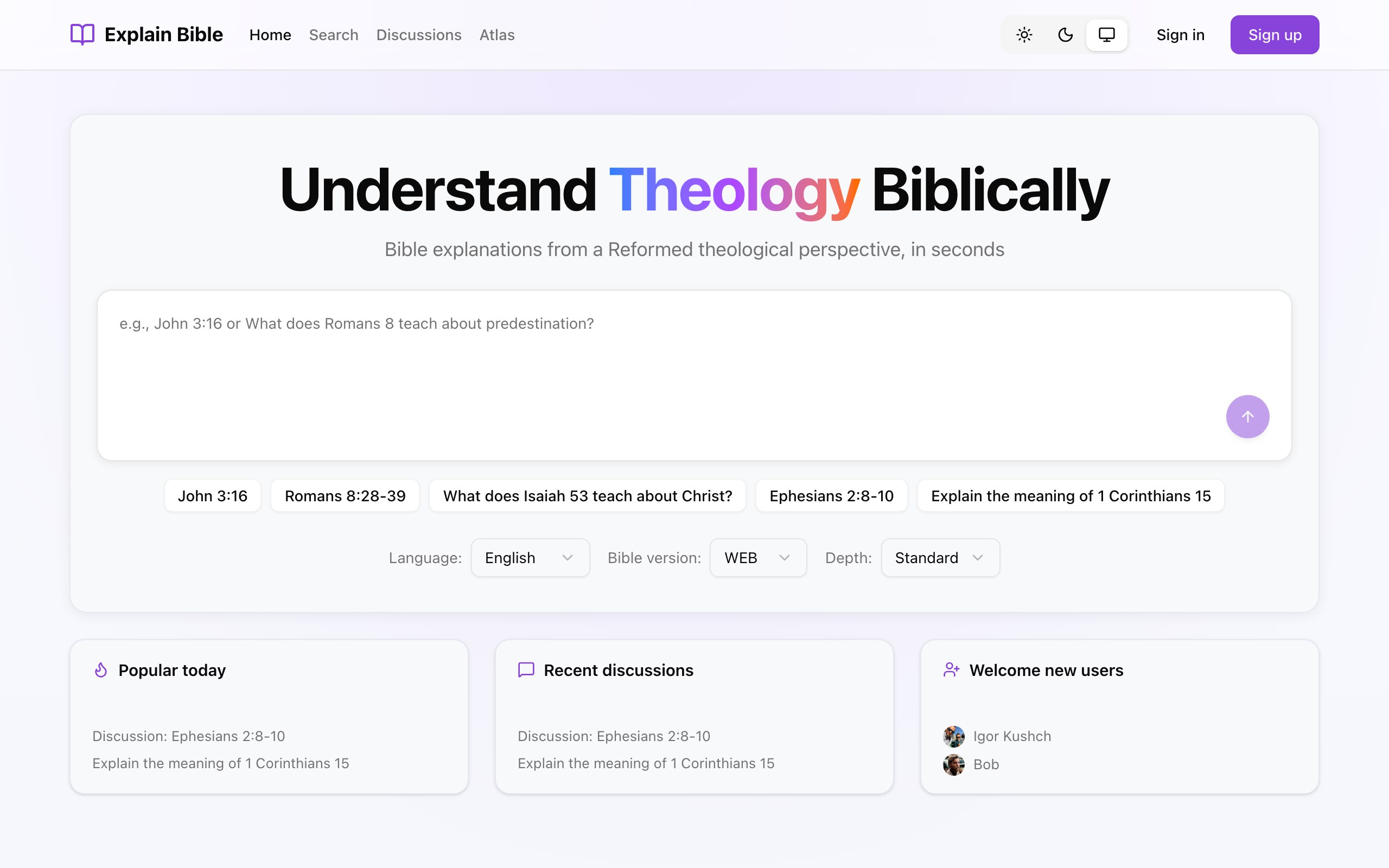
Grounding, not guessing
Retrieval runs on two deliberately different paths. For a specific passage, the system pulls the exact commentary that overlaps those verses, a tight Matthew Henry excerpt, a couple of Church Fathers, confession proof-texts, chosen by precise scripture ranges rather than a fuzzy match, so the same passage always resolves to the same grounded sources. For an open topical question, it switches to semantic search across an embedded corpus. The answer is then written from that retrieved material and cites it inline.
Consistent by design
Doctrinal consistency is enforced in the system itself. A versioned prompt locks the model to scope, frames user input as untrusted to resist prompt injection, and requires the answer to be written in the same language as the passage. Because the passage-grounding path is deterministic, answers can be cached and reused without drifting, which keeps the tool both reproducible and affordable.
A community around the questions
The tool is wrapped in a discussion board with posts, threaded comments, and voting ranked by both popularity and genuine disagreement, so the questions people care about surface and the conversation continues past a single answer.
Under the hood
Next.js and React with Supabase and Postgres, vector search through pgvector, streamed responses from a reasoning model, and support for more than forty Bible versions across roughly a dozen languages. The embedding size was chosen deliberately to fit the storage budget without giving up retrieval quality.