
Asking one model gives you one model's blind spots
Put a hard question to a single model and you get a single point of view, confident, fluent, and quietly narrow. Council AI convenes a team instead: a product manager, an architect, a skeptic, and others, who deliberate across several rounds and produce a decision brief with the recommendation, the trade-offs, and the dissent worth keeping.
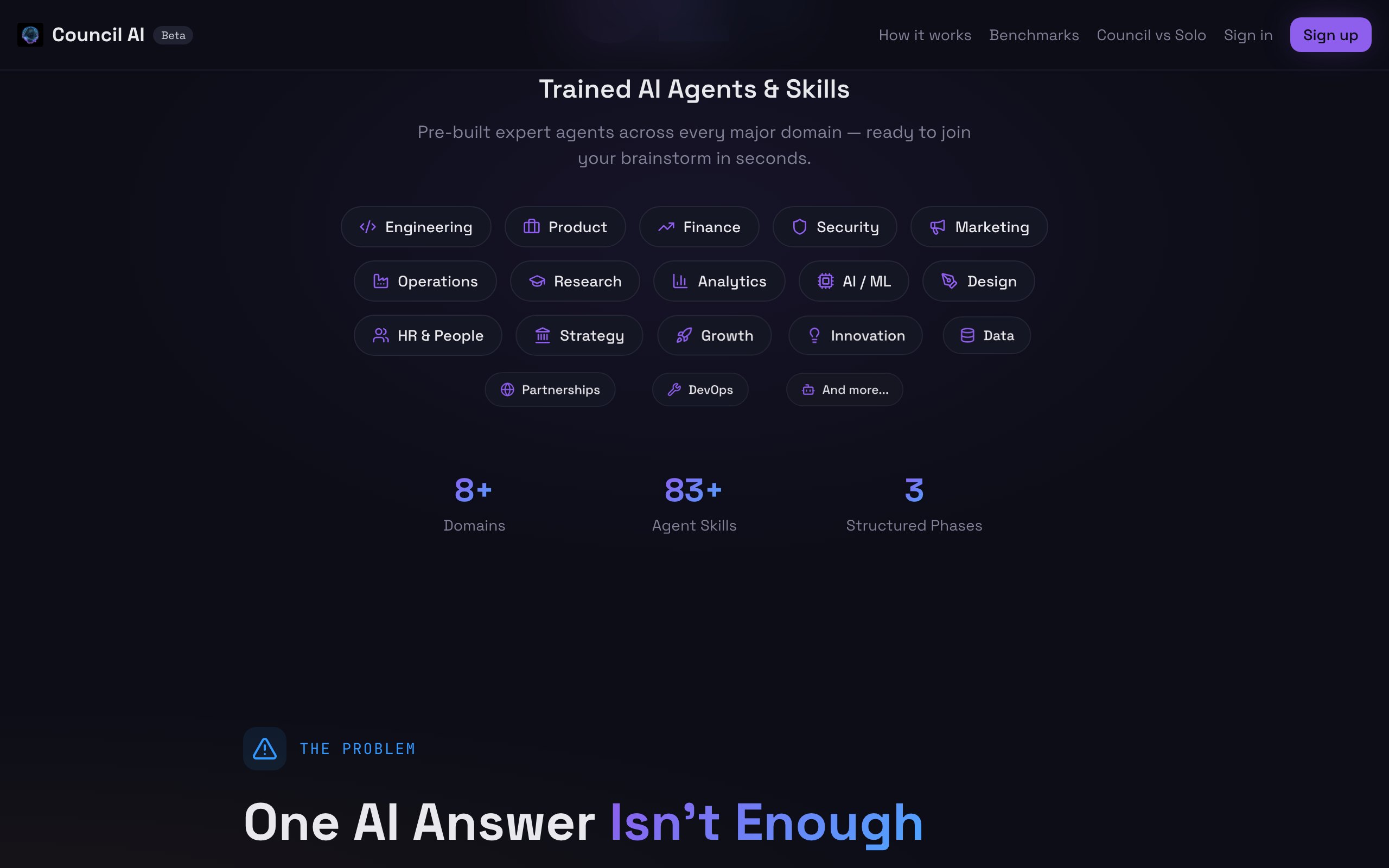
The obvious version of this fails in a specific way. Ask several models the same thing and they tend to converge, echoing each other into a consensus that feels rigorous and is not. Almost all of the real work went into preventing exactly that.
An engine built to prevent agreement
Each session runs through a seven-phase decision funnel, from framing the problem and mapping what is uncertain, through options, adversarial filtering, and a final test plan. Every phase emits a typed artifact, so the output is structured data, not a transcript.
Two mechanisms do the heavy lifting. Ideation uses a silent round: agents propose independently before they see each other, then critique anonymously, which keeps the loudest voice from setting the anchor. A diversity check then measures how similar the proposals are to one another and flags the moment the panel starts collapsing toward sameness, so the system can push it back apart.
Judging without the usual biases
When options are scored, the judges are drawn from different model families, and each sees the option list freshly shuffled and evenly trimmed, which cancels the position and verbosity biases that skew a single judge. Scores are confidence weighted, and any judgment that is really just a guess is discounted and routed into the test plan instead of being trusted. A red-team seat can raise a fatal objection that vetoes an option outright.
Under the hood
Next.js and React with a custom Socket.io server for live sessions, Prisma and Postgres, and a provider layer spanning Anthropic, OpenAI, and Google, with bring-your-own keys stored encrypted. Sessions are cancellable mid-run, survive restarts, and hold to a strict time budget with early exit once the panel genuinely converges.